
A well-built FAQ page can rank for 200+ keywords. I have seen it happen repeatedly with tourism clients, where a single FAQ page pulls in more organic traffic than a dozen blog posts combined. The problem is that most destination FAQ pages are afterthoughts: a dumping ground for random questions that marketing teams think visitors might ask.
That approach wastes enormous potential. When you treat FAQ pages as strategic SEO assets rather than customer service utilities, they become one of the most efficient ways to capture long-tail traffic and dominate People Also Ask boxes across dozens of related queries.
Why FAQ Pages Are SEO Gold for Destinations?
FAQ pages have structural advantages that make them uniquely powerful for SEO. Each question-answer pair is a self-contained content unit that can rank independently. Google can extract individual answers for featured snippets, PAA boxes, and now AI Overviews.
When I audited a Caribbean DMO site last year, their FAQ page ranked for 47 keywords. After restructuring it using the methodology below, the same page ranked for 312 keywords within four months. Traffic increased by 640%. The page did not get longer, it got smarter.
Destinations have another advantage: people ask highly specific questions that blog content rarely addresses. What is the best month to visit without crowds? Can I use US dollars at local restaurants? Is the tap water safe? These queries have real search volume, minimal competition, and high intent.
Step 1: Research Questions Like a Journalist, Not a Marketer
The biggest mistake I see is writing FAQ pages based on internal assumptions. Your marketing team thinks visitors want to know about your new sustainable tourism initiative. Actual searchers want to know if they need a plug adapter.
Mining Real Questions From Search Data
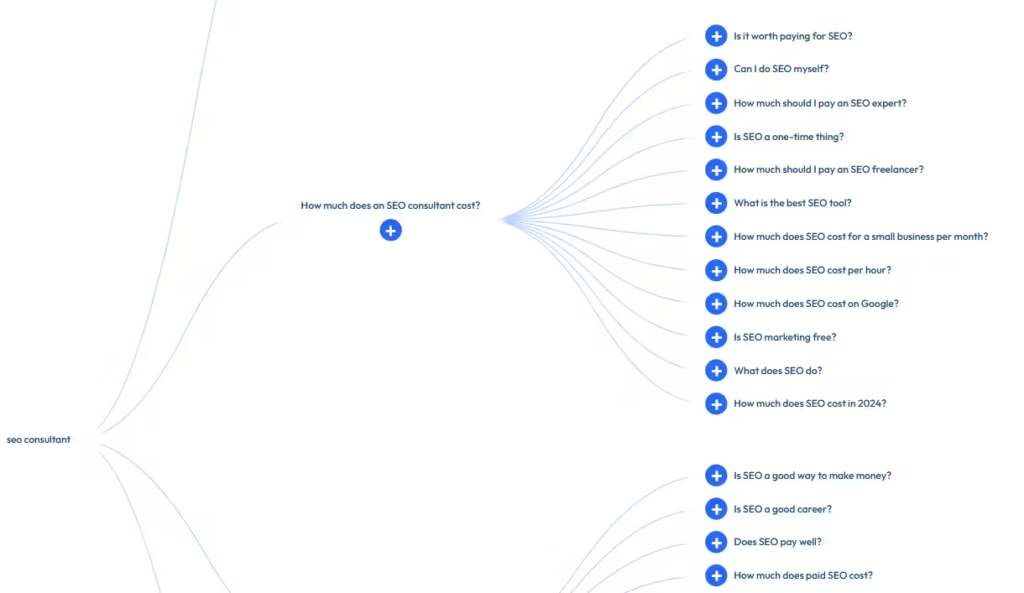
Start with AlsoAsked.com or the People Also Ask boxes in Google. Enter your destination name plus common modifiers: visiting [destination], traveling to [destination], [destination] vacation. Export every question you find.
Next, use AnswerThePublic for question modifiers. Filter by who, what, when, where, why, how, can, does, is. This gives you the grammatical structures real people use.
Then check your Google Search Console. Filter by queries containing question words. You will find questions your site already ranks for on pages 2-4. These are prime targets because Google already associates your domain with these topics.
Competitor FAQ Analysis
Scrape competitor FAQ pages and run them through Ahrefs or Semrush to see which questions drive traffic. I use Screaming Frog with custom extraction to pull all FAQ schema from competitor sites, then cross-reference with their ranking keywords.
For a Portugal DMO project, this approach revealed that competitors were missing entire question categories around digital nomad visas and remote work regulations. We built an FAQ section specifically targeting these queries and captured a keyword cluster that competitors had ignored.
Categorizing Questions by Intent and Volume
Group your questions into logical categories: practical travel info, costs and budgeting, safety and health, activities and attractions, local customs, seasonal considerations. Each category becomes an H2 section on your FAQ page.
Prioritize questions with search volume between 50-500 monthly searches. Higher volume questions deserve dedicated blog posts. Lower volume questions can still appear on your FAQ page but should not drive structural decisions.
Step 2: Structure Your FAQ Page for Maximum Keyword Coverage
Architecture matters more than word count. I have seen 1,500-word FAQ pages outrank 5,000-word versions because of superior structure.
The Cluster-Based FAQ Architecture
Organize questions into 6-8 thematic clusters. Each cluster gets its own H2 heading that includes a target keyword. Questions within each cluster become H3 headings or bold text depending on your design preferences.
Example structure for a destination FAQ page:
- H1: Frequently Asked Questions About Visiting [Destination]
- H2: Planning Your Trip to [Destination]
- H3: What is the best time of year to visit [Destination]?
- H3: How many days do you need in [Destination]?
- H3: Do I need a visa to visit [Destination]?
This structure allows Google to understand topical relationships and gives each question the heading weight it needs to rank independently.
Answer Formatting That Wins Featured Snippets
Google extracts FAQ answers for PAA boxes and featured snippets. Your formatting directly impacts extraction likelihood.
Keep the first sentence of each answer under 50 words. This sentence should directly answer the question without hedging or preamble. I call this the snippet sentence. Follow it with 2-3 sentences of supporting detail, context, or nuance.
- Bad example: “The best time to visit depends on many factors including your personal preferences, budget considerations, and what activities you are interested in.”
- Good example: “The best time to visit Costa Rica is December through April during dry season. Expect sunny mornings, afternoon clouds, and temperatures between 75-85°F. Prices peak during Christmas and Easter weeks.”
The good example gives a direct answer, then adds useful context. The bad example says nothing concrete in 26 words.
Word Count Per Answer
Aim for 75-150 words per answer. Shorter answers lack the depth Google needs for ranking confidence. Longer answers dilute the topical focus and reduce snippet extraction probability.
For complex questions requiring longer explanations, write a concise FAQ answer and link to a dedicated blog post for full details. This keeps your FAQ page scannable while building internal link equity to deeper content.
Step 3: Implement FAQ Schema Correctly
FAQ schema tells search engines exactly which content represents questions and answers. Proper implementation increases visibility in rich results and AI-generated answers.
JSON-LD Implementation
Use JSON-LD format in your page head or body. Do not use microdata or RDFa because they are harder to debug and maintain.
Each question-answer pair needs to be wrapped in a Question type with a nested acceptedAnswer of type Answer. The text property should contain only the answer content, not the question repeated.
Common mistakes I see: including HTML in the text property (strip it out), truncating long answers (include full text), using duplicate questions across pages (each question should appear once site-wide).
Testing and Validation
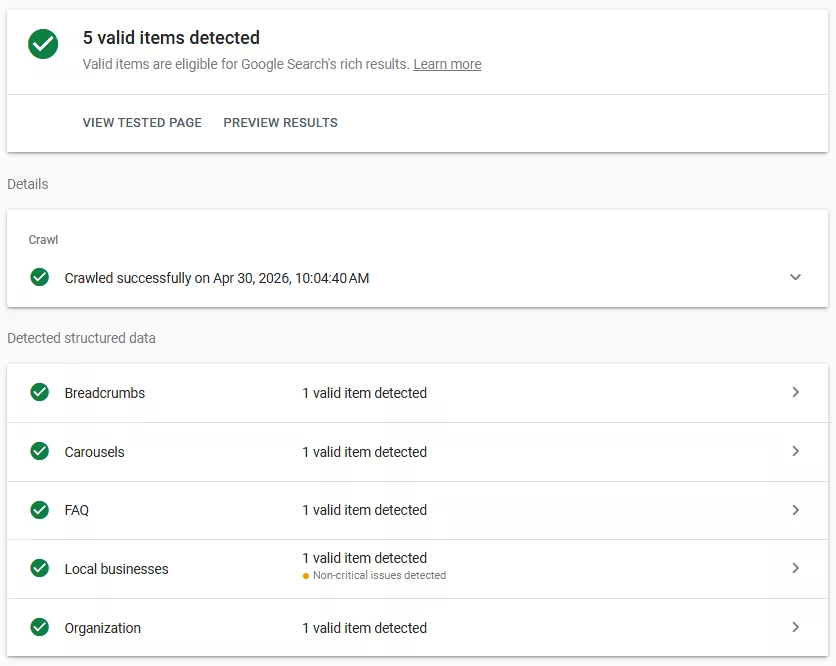
Run your page through Google’s Rich Results Test before and after implementation. Check that all Q&A pairs appear correctly in the preview panel. Then monitor Search Console’s Enhancements report for FAQ markup errors over the following weeks.
I recommend adding FAQ schema incrementally. Add 10-15 questions initially, validate, then expand. This makes debugging easier when errors appear.
When Not to Use FAQ Schema?
Google’s guidelines specify that FAQ schema should only mark up questions authored by the site itself, not user-generated content. Do not apply FAQ schema to forum threads, review responses, or community-submitted questions.
Also avoid marking up promotional content disguised as FAQs. “Why is [Destination] the best place for your next vacation?” is marketing copy, not a genuine FAQ. Google’s spam algorithms increasingly detect and penalize this pattern.
Step 4: Internal Linking From and To Your FAQ Page
An FAQ page should function as a hub connecting users to deeper content across your site. Every answer is an opportunity to link contextually to relevant pages.
Linking Out From FAQ Answers
Each answer should include one internal link to the most relevant deeper page. If someone asks about the best hiking trails, link to your hiking page or a detailed trails guide. Keep anchor text natural and descriptive.
I mapped a client’s FAQ page links to their site architecture and found 70% of answers linked to the homepage or contact page. This wasted the contextual linking opportunity. We revised to link each answer to the most topically relevant content, and those destination pages saw ranking improvements within six weeks.
Linking To Your FAQ Page
Your FAQ page needs inbound internal links to build authority. Add links from your homepage, main navigation, and contextually relevant blog posts. Use varied anchor text: FAQ, frequently asked questions, common questions about visiting [destination], travel tips and answers.
Blog posts should link to specific FAQ sections using anchor links. If your blog post mentions visa requirements, link directly to your FAQ’s visa question (#visa-requirements) rather than the generic FAQ page. This passes more relevant signals.
Step 5: Maintain and Expand Your FAQ Page Over Time
FAQ pages are not set-and-forget assets. Search behavior changes, new questions emerge, and existing answers become outdated.
Monthly Review Process
Check Search Console monthly for new queries driving impressions to your FAQ page. When you see questions you have not explicitly answered, add them. When you see declining clicks on existing questions, review and refresh those answers.
Track PAA boxes for your main destination keywords. Google rotates questions seasonally, adding new ones based on current search patterns. Capture these fresh questions before competitors do.
Seasonal Question Clusters
Add seasonal FAQ sections 2-3 months before peak interest. Questions about Christmas markets should be live by September. Questions about summer festivals should be live by March. Use Google Trends to identify when interest begins rising for seasonal topics.
For a European client, we added a winter sports FAQ section in August. By November, those questions ranked in positions 1-3 and drove significant traffic during their high-booking period.
Pruning and Consolidating
Not every question earns its place permanently. If a question generates zero impressions over 6 months, remove it or merge it with a related question. FAQ pages lose effectiveness when bloated with irrelevant content.
Review your FAQ page quarterly and remove any question that is not ranking, not driving clicks, and not serving a clear user need.
Frequently Asked Questions
How many questions should a destination FAQ page have?
Aim for 30-60 questions organized into 6-8 thematic clusters. Fewer than 20 questions lacks the depth to rank for multiple keywords. More than 80 questions becomes unwieldy and dilutes topical focus. Start with your highest-volume, highest-intent questions and expand gradually based on performance data.
Should I put all FAQs on one page or split them across multiple pages?
One comprehensive FAQ page works better for most destinations. Splitting FAQs across multiple pages fragments your authority and creates internal competition. The exception is if you have 100+ questions, in which case category-specific FAQ pages (transportation FAQ, safety FAQ, activities FAQ) with a main FAQ hub can work well.
How often should I update my FAQ page?
Review monthly for new questions appearing in Search Console and PAA boxes. Update answers whenever information changes, such as visa requirements, pricing, or seasonal details. Major content additions or restructuring should happen quarterly at minimum. Stale FAQ pages lose rankings to fresher competitors.
Does FAQ schema guarantee rich results in Google?
No. FAQ schema improves eligibility for rich results but does not guarantee them. Google displays FAQ rich results selectively based on query type, competition, and their current SERP layout preferences. Proper schema implementation significantly increases your chances, but expect rich results on perhaps 20-40% of your ranking queries, not all of them.
Can FAQ pages rank for featured snippets?
Yes, and they are particularly effective for paragraph snippets and People Also Ask inclusion. The key is formatting answers to start with a direct, concise response in the first sentence. FAQ pages often capture multiple featured snippets simultaneously because each question-answer pair is independently optimized for extraction.
Should I include questions about competitors or comparisons?
Yes, when the questions reflect genuine search behavior. Questions like “Is [destination] better than [competitor destination] for families?” have real search volume and buying intent. Answer these questions honestly, highlighting your destination’s strengths without disparaging competitors. Comparative questions often have lower competition and higher conversion intent.
Ready to Build an FAQ Page That Actually Performs?
Most destination FAQ pages underperform because they are built reactively instead of strategically. The methodology above transforms FAQ pages into traffic-generating assets that capture long-tail queries, dominate PAA boxes, and support your entire content ecosystem through strategic internal linking.
If you want help auditing your current FAQ page or building one from scratch, I offer consulting engagements specifically for DMOs and tourism brands. Reach out through my contact page and let me know what destination you are working with.

About the Author
I’m Peter Sawicki, a Destination SEO Strategist helping tourism brands and DMOs grow their online presence through SEO, technical audits, and creative digital strategies. Over the years I’ve worked across multiple countries and markets, which gives me a global perspective on every project I take on. When I’m not optimizing websites, you’ll most likely find me underwater. Scuba diving is where my two biggest passions meet.